Rapid ‘Ōhi‘a Death Research
The native ‘ōhi‘a tree is a keystone and culturally important species in Hawai‘i

‘Ōhi‘a are a keystone species and the dominant native forest tree in Hawai‘i. They are pioneer species on new lava flows, and provide key habitat to many other native and endemic species. They also hold great significance in indigenous Hawaiian culture. The ‘ōhi‘a is the subject of many moʻolelo (Hawaiian legends), and its vibrant lehua blossoms are often used in making lei worn during hula.
The Rapid ‘Ōhi‘a Death (ROD) disease has devastated ‘ōhi‘a forests
Hawai‘i’s forests are currently threatened by Rapid ‘Ōhi‘a Death (ROD), a disease of the native ‘ōhi‘a tree. ROD was first characterized in 2014 and has since devastated ‘ōhi‘a forests, with >90% mortality in some areas on Hawai‘i Island. Researchers found that ROD is caused by two novel, invasive fungal pathogen species, Ceratocystis lukuohia and Ceratocystis huliohia. Although much work has been done to characterize this unprecedented disease and develop practical methods for detection and prevention, we don’t yet understand how these two distinct pathogens evolved to infect the ‘ōhi‘a upon introduction to Hawai‘i.
Producing genomic resources for studying the evolutionary history of ROD in Hawai‘i
My work will characterize the evolutionary history of ROD through comparative genomic analyses. Over the years since 2014, my collaborators at the USDA-ARS in Hawai‘i have isolated and archived fungal samples from infected ‘ōhi‘a throughout the Hawaiian Islands. I will generate long-read genome sequencing datasets of these isolates, assemble high quality genomes, and investigate their diversity and evolutionary history. Understanding the evolutionary histories and invasion dynamics of these two pathogens will help to inform appropriate management strategies of ROD and increase preparedness for handling future diseases of the ‘ōhi‘a.
Progress so far
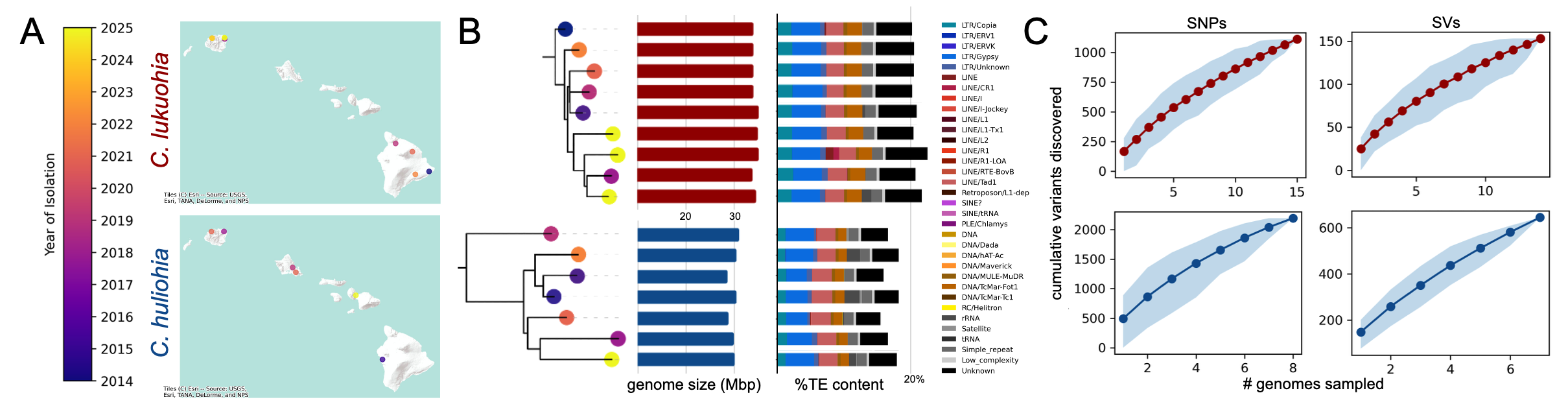
Thus far, I have optimized fungal culture, high molecular weight DNA extraction, and library preparation methods for the ROD species, and produced an initial set of long-read genome assemblies. My preliminary analyses of these genomes show that C. lukuohia has a larger genome size and greater TE content than C. huliohia. Additionally, analysis of single nucleotide polymorphisms (SNPs) and SVs show greater diversity in C. huliohia than C. lukuohia, as expected. However, diversity analyses also show that further sequencing is necessary to fully capture the variation within both species.